Investor Portals for Compliance and Driving Interest
Fund close timelines have extended from roughly 15 months pre-pandemic to 20 months today, while LP selectivity has increased, and global fundraising has declined year-over-year. Two-thirds of LPs plan to concentrate commitments with existing managers, making the servicing experience a primary mechanism for not merely retaining capital but driving interest in new funds. Regulatory changes — GDPR, AIFMD, MiFID II, SEC marketing rules — mean that manual compliance workflows carry real risk.
How AI Works for Investor Relations
AI changes the economics of investor relations at the individual LP level. Preparing for LP meeting used to mean manually pulling notes from email, cross-referencing CRM records, and checking a separate portal and hours of work for associates. AI-assisted preparation assembles that context automatically as a pre-meeting brief; post-meeting, it captures notes and extracts next steps in seconds. Across hundreds of LP relationships, this compounds both in terms of completeness & quality, not just time.
The questions below cover what modern investor services actually does, what to look for in an Investor Services platform or Investor Portal, and how InvestorFlow approaches the category.
Frequently Asked Questions
Q: What does an investor services platform actually cover?
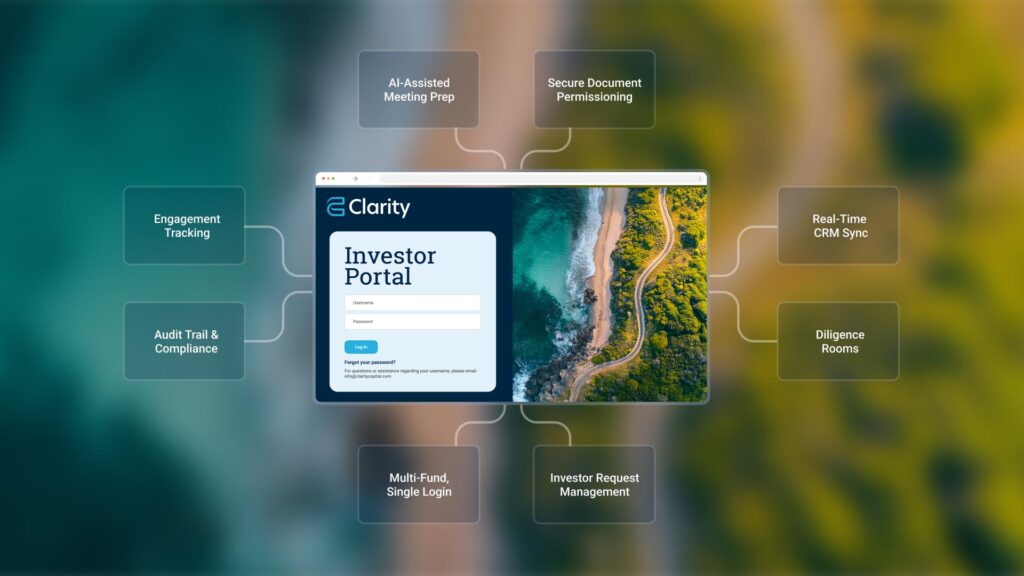
A: Often called an investor Portal or LP portal, an investor services platform manages the operational infrastructure of LP relationships — document delivery, capital activity communications, reporting, permissioning, and investor request handling across the full fund lifecycle – as well as the internal operations to make it happen at scale. The most complete implementations cover both the LP-facing portal experience and the internal IR workflow, connecting what LPs see with what the investor relations / investor services team manages. A platform that covers only one side — the portal but not the IR workflow, or the CRM but not the portal — requires manual reconciliation across systems to maintain a coherent view of each relationship.
InvestorFlow Investor Services covers both sides of the equation. The platform serves GP-side IR and investor services teams through a unified relationship and operations environment, and it serves LPs through a firm-branded portal connected to the same underlying data. Capital activity, document permissions, engagement history, and servicing records are shared across both environments in real time, so the IR team always has the context they need, and LPs always see an accurate, current view of their relationship.
Q: Should firms have a unique portal for every individual fund, or should the firm manage a single portal that supports individual funds, fund families, and investors?
A: The state of the art is a single, unified portal that supports multiple funds and fund families under one experience, rather than separate portals for each fund or strategy. The right starting point is the LP's perspective: investors with commitments across multiple strategies want one place to access all their holdings, communications, and documents, not a separate login and interface for each fund. Fragmented portals create access friction for investors and access-management complexity for IR teams, both of which worsen as the firm grows.
InvestorFlow enables firms to consolidate multiple portals into a single connected environment. As GPs launch new strategies or expand through acquisitions of specialist managers, the platform supports the addition of new fund families and investor bases without requiring separate portal infrastructure. A single permissioning engine governs access across all funds and entities, so the IR team manages one system rather than reconciling multiple portals with different access controls, document structures, and investor records.
Q: What should a GP-side IR team expect from a modern investor services platform?
A: Internal users should be able to manage LP contacts, track investment history, monitor engagement, initiate capital activity, initiate and control document distribution, and respond to investor requests from a single environment. A key indicator of platform maturity is whether interaction history is shared across team members, so any member of the IR or client service team can serve an LP with full context, without locating records across email, a CRM, and a separate portal. Prioritized servicing dashboards that organize LP requests by work type are a further differentiator for teams managing volume across multiple funds.
InvestorFlow provides a unified internal environment covering investor management, interaction history, document permissioning, pipeline management, and investor request handling. The investor servicing module captures incoming LP requests, routes them to the appropriate team member, and tracks resolution through completion with a complete audit trail. IR teams monitor LP engagement directly from the same platform where they manage the relationship with no switching between tools to understand how a given investor is engaging with the portal.
Q: What should the LP portal experience look like today?
A: A modern LP portal should provide investors with secure, self-service access to capital accounts, performance reporting, fund documents, and capital activity notifications, accessible on both desktop and mobile. It should support multi-strategy views for investors with commitments across multiple funds, and it should deliver communications through the portal and by email with LP-managed preferences. Personalization — communications and content tailored to each LP's profile and fund participation — has shifted from a differentiator to a baseline expectation among institutional investors.
InvestorFlow's LP portal is firm-branded and accessible across desktop and mobile, with multi-strategy views for investors holding commitments across multiple funds. Capital call notices, distribution notices, quarterly reports, and investor letters are delivered through the portal and by email in a unified branded format. Communication preferences are managed by each LP, and portal content reflects the firm's permissioning rules automatically with no manual configuration required at the LP level. Further, InvestorFlow supports investor services requests so that teams can log and tack all investor needs.
Q: What should document permissioning look like in an investor services platform?
A: Document permissions in a mature investor services platform should operate at the fund, vehicle, commitment, contact, and document-category levels, meaning a single LP contact can hold different access rights across multiple funds and entities, and access to specific document types (K-1s, quarterly letters, subscription materials) can be configured independently. Permissioning logic should be maintained in the CRM as the system of record and synchronized to the portal automatically, rather than managed in the portal directly or in a separate spreadsheet. For firms with cross-border LP bases, jurisdictional gating, restricting fund visibility and document access based on investor jurisdiction, should be enforceable at the platform level.
InvestorFlow enforces permissions at the fund, vehicle, commitment, contact, and document-category levels, managed in the CRM and synchronized to the portal in real time. Every document interaction is logged with timestamps, user attribution, and IP detail. Dynamic watermarks, view-only restrictions, and configurable disclaimers with logged acknowledgments are available across all document types. For firms managing LP bases across multiple jurisdictions, the platform supports jurisdictional gating aligned with AIFMD, MiFID II, and related frameworks.
Q: How do investor services platforms reduce the manual work of quarterly document distribution?
A: Investor services platforms must support batch document upload and distribution, automating the matching of documents to entitled investors based on permissions and fund participation. Exception reporting, identifying missing files or permissioning gaps before distribution goes out, is a key capability that reduces the manual verification that typically precedes large-scale distributions. Notification delivery through the firm's branded templates should be part of the same workflow, not a separate step. The result is a process where the primary human input is the upload itself; everything downstream is automated and auditable.
IR teams upload batch files from fund administrators, and InvestorFlow automatically matches documents to entitled investors based on permissions synced from the CRM. Exception reporting identifies missing files and permissioning gaps before distribution is released. Notifications route through the firm's branded communication templates within the same workflow, and a reconciliation report documents what was sent, to whom, and when. A mid-market private credit firm using InvestorFlow compressed a quarterly reporting cycle that previously took close to three weeks — involving manual file-matching across two administrators and side-letter verification in a separate spreadsheet — to a single morning's work.
Q: Should LPs be able to retrieve their own documents without contacting the IR team?
A: LP self-service access to documents, statements, and performance data is a standard expectation in modern investor services platforms — and a meaningful operational lever for IR teams. When LPs can retrieve K-1s, capital account statements, quarterly reports, and performance dashboards directly from the portal, inbound inquiry volume drops substantially, particularly during quarterly reporting season when request spikes are most acute. The design implication is that the portal must be reliable, current, and easy to navigate without IR assistance; a portal that requires frequent IR intervention to explain or fulfill access defeats the purpose.
Self-service access is a core design principle of InvestorFlow's LP portal. Investors retrieve K-1s, capital account statements, quarterly reports, and performance dashboards directly, without contacting the IR team. The platform's permissioning engine ensures that each LP sees only the documents they are entitled to, so the IR team does not need to manage individual access requests for routine document retrieval. For firms where quarterly reporting season produces a sustained spike in inbound inquiries, this reduction in contact volume is one of the clearest near-term benefits of implementation.
Q: How should capital call and distribution notices be delivered to LPs?
A: Capital call and distribution notices should be generated and delivered through configurable channels — portal, email, or both — with complete audit trails documenting delivery, receipt, and investor acknowledgment. The platform should connect to fund administrator data so that capital activity is reflected in LP accounts without manual re-entry, and delivery formats should be configurable by LP. Audit documentation for capital activity communications is increasingly important as regulatory scrutiny of investor communications grows.
InvestorFlow generates and delivers capital call and distribution notices through configurable channels, with complete audit trails covering delivery, receipt, and acknowledgment. The platform connects to fund administrator data, so capital activity updates LP accounts without manual re-entry. Firms configure delivery cadences and formats at the LP level, and the entire process produces the compliance documentation needed for internal review and external examination.
Q: Can investor communications be personalized at scale without a separate marketing tool?
A: Personalized investor communications, content tailored to each LP's fund participation, profile, and preferences, should be deliverable through the investor services platform rather than requiring a separate marketing or email tool. The key capability is a unified communication history: every message sent to every LP, stored in the same environment where the relationship is managed, so the IR team can see the full context of what an investor has received without switching systems. For firms managing multi-strategy LP bases, the platform should support communications segmented by fund, strategy, or investor type within a single workflow.
InvestorFlow delivers personalized communications across portal and email in a unified branded format, with no requirement for a separate marketing tool. Communications are configurable by fund, strategy, LP profile, or communication preference, and the platform maintains a complete history of every message sent to each LP alongside the rest of the relationship record. Capital calls, performance updates, firm announcements, and investor letters all route through the same environment, so the IR team's view of each LP includes what they've been sent, what they've opened, and what they've accessed in the portal.
Q: When distributing documents, what controls should be enabled to ensure that investor services teams do not release information to the wrong users?
A: Document distribution controls should operate at granular levels, down to the individual investor contact, not just the firm or fund level. Before any distribution, the platform should allow administrators to verify exactly who has access to a given document, with the ability to identify and correct gaps before materials go live. The ability to replace or update a document without changing access links is a practical safeguard: when a file needs to be corrected after distribution, the fix should not require revoking and re-sharing access or breaking existing LP bookmarks. For VIP or sensitive LP relationships, the ability to preview the portal as a specific investor, to confirm precisely what they will see, removes ambiguity from high-stakes distributions.
InvestorFlow enforces granular document controls at the individual user level, with a complete log of who has access to what and when permissions were granted or changed. The impersonation capability allows administrators to verify the exact portal experience of any given LP or VIP contact before a distribution is released. Confirming access is correct without relying on manual review of permission spreadsheets. The platform also supports document replacement without link changes, allowing administrators to swap an incorrect or updated file without disrupting existing access or requiring LPs to use a new URL. These controls make it possible to manage large-scale distributions across complex multi-entity, multi-fund structures with confidence.
Q: What reporting capabilities should an LP-facing platform provide?
A: LP-facing reporting capabilities must be able to cover capital accounts, performance metrics, portfolio commentary, and fund-level data — distributed in compliant digital formats with configurable cadences by LP. Multi-currency reporting is a necessity for firms with global LP bases, where investors need to view commitments, contributions, distributions, and NAV in their commitment currency or a preferred reporting currency. Bulk distribution workflows, covering the entire LP base in a single coordinated process rather than fund-by-fund manual steps, are a significant operational differentiator at scale.
InvestorFlow supports the generation and distribution of compliant digital reports covering capital accounts, performance metrics, portfolio commentary, and other investor-facing content. Report format and cadence are configurable by LP, and the portal serves as a permanent, secure home for statements and documents. Multi-currency reporting is available for global LP bases, and bulk distribution workflows ensure that large-scale reporting delivery is a coordinated, auditable process rather than a manual one.
Q: How can IR teams get visibility into which LPs are engaging with their materials?
A: Engagement tracking, covering LP logins, document views, time on page, and download activity, allows IR teams to prioritize outreach based on actual behavior rather than assumptions. In fundraising contexts, engagement signals from diligence room activity can surface buying interest before it is expressed directly. Across the existing LP base, engagement analytics help identify at-risk relationships where activity has declined and proactive outreach is warranted. This kind of visibility was previously only available to firms using purpose-built marketing analytics tools alongside their portal.
InvestorFlow tracks LP activity across the portal — login frequency, document views, time on page, and download behavior — and surfaces this data to IR teams in an engagement dashboard. Teams identify which LPs are actively engaging with materials and which have gone quiet, so they can focus outreach ahead of a fundraise or re-up cycle. Engagement data from diligence rooms feeds into the same view, giving the IR team a prospective investor's full interaction history from initial outreach through diligence in one place.
Q: IR teams spend most of their working day in email, not in a CRM. How should an investor services platform handle that reality?
A: CRM systems in investor relations contexts often fall short not because of capability gaps but because they require professionals to log activity manually, a discipline that is difficult to sustain across teams managing hundreds of LP relationships. When CRM entry competes with investor interaction time, records fall behind and the system loses value. The more durable approach is a platform designed around email and calendar integration: one that captures relationship activity automatically from the tools IR teams already use, rather than requiring a parallel workflow to maintain records.
InvestorFlow integrates directly with Outlook and Microsoft 365, capturing email and calendar activity and surfacing it within the relationship record for each LP without manual data entry. The Outlook add-in extends the platform into the environment where IR teams spend the majority of their day, so accessing relationship context, logging an LP interaction, or preparing for a meeting can happen without leaving email. Activity history stays current in practice, not just in principle, because it is captured through the workflow teams already follow rather than requiring a separate step.
Q: How should investor request management work in a modern IR platform?
A: Investor request management — covering intake, routing, tracking, and resolution of LP inquiries — should operate within the investor services platform rather than through separate inboxes or ticketing tools. The key capabilities are structured intake that captures requests by type, configurable routing to the appropriate team member, and a shared audit trail that documents resolution status across the team. For firms with multiple strategies and a large investor base, volume management through prioritized dashboards by work type is a practical necessity.
InvestorFlow includes a dedicated investor servicing module that captures incoming LP requests, routes them to the appropriate team member, and tracks resolution through completion. Requests are organized by work type with prioritized dashboards, and coordination across team members happens within the platform rather than across email threads. All activity is logged with a complete audit trail, so compliance teams can document how and when investor requests were addressed.
Q: What compliance and audit trail capabilities does an investor services platform need?
A: A compliant investor services platform logs all user activity — logins, document views and downloads, permission changes, disclaimer acceptances — with timestamps, user attribution, and IP detail, retained for the firm's records-retention period and exportable for internal and external review. Maker-checker workflows, which separate the users who upload documents from those who release them to investors, are a standard control in regulated environments. For firms operating across multiple jurisdictions, jurisdictional gating and per-user disclaimer logging are additional requirements that manual processes cannot reliably enforce at scale.
InvestorFlow logs all user activity with timestamps, user attribution, and IP detail, retained for the firm's records-retention period and exportable for compliance review or external examination. The platform supports maker-checker workflows requiring approval before documents are published to investors. Investment-level access controls eliminate the manual risks of spreadsheet-based permissioning, and jurisdictional gating enforces cross-border marketing compliance automatically rather than through manual verification.
Q: How does an investor services platform integrate with fund administrators and CRMs?
A: Effective investor services platforms function as integration hubs, not isolated environments. Core integrations include fund administrator platforms (for capital account data, NAV, and statements without manual re-entry), CRM systems (for bidirectional synchronization of investor records, relationship history, and permission assignments), and enterprise identity and access management systems (for SSO and MFA). Integration reliability, including retry logic for failed syncs and reconciliation reporting to identify data integrity gaps, matters as much as the integrations themselves.
InvestorFlow integrates with fund administrator platforms including SS&C, Citco, Apex, and CSC, ingesting capital account data, NAV calculations, and investor statements without manual re-entry. It synchronizes bidirectionally with CRM systems including Salesforce, DealCloud, and Dynamo, with near-real-time latency and reconciliation reporting to maintain data integrity. The platform also supports enterprise IAM integrations for SSO and MFA and connects to third-party digital onboarding and KYC platforms for subscription workflows.
Q: Do investor services platforms support fundraising diligence rooms?
A: Diligence rooms — secure, firm-branded environments where fundraising materials are shared with prospective investors — should ideally be part of the investor services platform rather than a separate tool. When diligence rooms are connected to the same permissioning and relationship infrastructure as the rest of the platform, engagement data from the diligence process automatically enriches the LP relationship record. When diligence rooms are separate tools, that engagement history must be reconciled manually, and the IR team loses visibility into the prospective investor's full interaction history.
InvestorFlow includes diligence rooms functionality natively. IR teams provision secure, firm-branded diligence rooms with tiered access controls, organized folder structures, and automatic engagement tracking. Because diligence rooms are connected to the same permissioning and relationship infrastructure as the LP portal, engagement data from a prospect's diligence activity feeds directly into the relationship record, giving the IR team a full engagement history, from first outreach through fund close, in one place.
Q: Should investor portals support the investor onboarding process and electronic subscription documents (eSubDocs)?
A: Yes, and for firms managing significant LP volume, digital onboarding and electronic subscription documents are a must-have component of the overall investor portal strategy. The subscription process is often the first operational touchpoint that committed investors have with a firm's digital infrastructure, and friction at that stage creates a poor first impression that is difficult to reconcile with a strong ongoing portal experience. Digital subscription workflows reduce administrative overhead for both the LP and the IR team, support compliance requirements around document execution, and accelerate the path from commitment to funded investor.
InvestorFlow supports digital onboarding and electronic subscription document workflows through integrations with specialist onboarding platforms. Rather than requiring firms to rebuild existing subscription processes from scratch, InvestorFlow's integration approach is designed to work with the onboarding infrastructure and provider relationships firms already have in place. This means firms gain a connected end-to-end onboarding experience — from diligence room through subscription document execution — without disrupting the established processes they rely on.
Q: How do investor services platforms handle KYC (Know Your Customer) and AML (Anti-Money Laundering) requirements?
A: KYC and AML requirements are an increasingly central part of investor onboarding and ongoing LP management, particularly for firms operating across multiple jurisdictions. A capable investor services platform should support structured collection and verification of investor identity documentation, facilitate regulatory screening including OFAC sanctions checks, and maintain complete, auditable records of all compliance activities at the investor and fund level. For firms onboarding large numbers of LPs across a global investor base, the volume of compliance documentation that must be collected, verified, and retained makes manual workflows a practical liability and a compliance risk.
InvestorFlow addresses KYC and AML requirements through its integrated onboarding capabilities, connecting to third-party identity verification and regulatory compliance platforms. The platform facilitates OFAC screening, KYC documentation collection, and related regulatory workflows as part of the digital subscription process, with compliance activities logged and retained as part of the firm's complete audit trail. This keeps onboarding compliance connected to the broader investor services environment, so identity records, regulatory screening history, and fund subscription documentation are maintained within a single platform rather than fragmented across separate compliance tools.
Q: What does implementation look like for a new investor services platform?
A: Implementation for an investor services platform typically proceeds in phases: core portal and permissioning capabilities first, followed by reporting workflows, integrations, and more advanced configurations. For firms migrating from a legacy portal, document migration is often the most operationally intensive component. The volume of historical documents, accuracy of metadata, and configuration of permissions in the new environment all require structured project management. Data migration, integration configuration, and user onboarding are the three primary workstreams, and the sequence matters: permissioning rules must be accurate before the first document distribution goes out.
InvestorFlow's implementation team works within a structured process covering data migration, integration configuration, and user onboarding, with core portal and permissioning capabilities deployed first. InvestorFlow has managed document migrations involving hundreds of thousands of files across enterprise implementations, with exception reporting built into the migration process to catch permissioning gaps before go-live. The advisory team remains engaged throughout to ensure the configuration reflects the firm's fund structure, LP base, jurisdictional requirements, and compliance posture.
Q: How do IR teams transition from email and spreadsheets to a dedicated platform?
A: Successful adoption of an investor services platform depends on two factors: the platform being genuinely designed for IR workflows rather than adapted from a generic CRM, and the implementation process including structured change management rather than just technical configuration. Teams that see the fastest adoption are typically those where the prior workflow created the most obvious friction: quarterly reporting cycles consuming multiple weeks, LP requests routed across multiple inboxes with no shared tracking, permissions managed in spreadsheets requiring manual verification before every distribution. When the platform visibly reduces pain the team experiences every quarter, adoption follows.
InvestorFlow's IR-side interface is built for IR and investor services workflows specifically, not for a generic CRM user. The platform complements existing tools through email and calendar integration via the Outlook add-in, which means the shift to the platform does not require teams to abandon the tools where they already spend their day. Structured change management is part of the implementation process, and the advisory team works with each firm to sequence the rollout in a way that delivers visible early wins.
Q: What AI capabilities are available now for investor services and IR teams?
A: The AI capabilities that matter most for IR and investor services workflows are those that reduce the manual work surrounding every LP interaction: automated capture of relationship activity from email and calendar data, AI-assisted meeting preparation that assembles LP context from across the platform, post-meeting documentation that extracts notes and next steps, and relationship intelligence that surfaces engagement patterns across the LP portfolio. Not all investor services platforms offer these capabilities today, but this is what IR teams should be evaluating for. Platforms that deliver on them address the most time-intensive parts of IR work and compound in value as the number of relationships under management grows.
InvestorFlow's AI Productivity Core is available now to all CRM users and covers automated email and calendar mining, meeting preparation assistance, post-meeting documentation, next-steps extraction, and relationship intelligence. Ahead of an LP meeting, the platform assembles a pre-meeting brief from email history, calendar activity, portal engagement, and CRM records. After the meeting, it captures notes and extracts follow-up actions without requiring the IR professional to manually update records. The Outlook add-in extends these capabilities into the email environment where IR teams spend a substantial part of their day.
Q: What AI capabilities for investor services are on the near-term roadmap?
A: Emerging AI capabilities in investor services include engagement scoring derived from portal activity, AI-assisted prioritization of investor service requests, and automated detection of disengagement signals across the LP base. These capabilities build on the engagement and interaction data that modern platforms already capture, applying AI reasoning to surface patterns that would be difficult to detect at scale through manual review. The near-term direction in the category is toward AI that proactively surfaces relationship risk and opportunity, rather than simply automating administrative tasks.
InvestorFlow is actively developing application-specific AI capabilities for investor services, including LP engagement signals derived from portal activity and AI-assisted prioritization of investor service requests. These capabilities are on the near-term roadmap and are informed by the engagement and interaction data the platform already captures across hundreds of thousands of LP relationships. When available, they will enable IR and servicing teams to identify elevated or declining engagement signals and to route requests based on context and urgency.
Q: How is a connected investor services platform different from a standalone LP portal?
A: A standalone LP portal handles document storage and delivery for investors but operates separately from the IR team's relationship management workflow. The practical implication is that when an LP engages with materials in the portal, that activity is not visible to the IR team in the environment where they manage the relationship; it must be retrieved separately or reported manually. A connected investor services platform integrates the portal with the CRM, the servicing workflow, and the engagement layer, so all interaction data is shared in one environment, and the IR team maintains a continuous, current view of every LP relationship without manual reconciliation.
InvestorFlow treats investor services as a connected operating model. The portal, the CRM, the investor servicing workflow, and the AI layer share the same data model and relationship history. When an LP logs into the portal, reviews a diligence room, or submits a service request, that activity is immediately visible to the IR team in the same environment where they manage the relationship, enabling action on engagement signals in real time, rather than waiting for a separate report or reconciling data across systems.
Q: What ROI can firms realistically expect from a modern investor services platform?
A: Documented outcomes from investor services platform implementations typically fall into three categories: operational efficiency gains (reduced time on quarterly reporting, document distribution, and LP request handling), compliance improvements (more reliable audit trails, consistent permissioning, and reduced manual risk), and relationship quality improvements (better LP experience, reduced inbound inquiry volume, and improved engagement visibility). Quantifying ROI requires baseline data on the time currently spent on manual processes, and the most credible estimates come from firms that have tracked the before-and-after on specific workflows.
Across implementations in private equity, private credit, and real assets, InvestorFlow clients report meaningful reductions in manual effort, with teams citing up to an 80% reduction in preparation time for investor interactions through AI-assisted workflows. Quarterly reporting cycles that previously required multiple weeks compress to hours. Inbound inquiry volume from LPs decreases as self-service portal access replaces routine document requests. Compliance posture improves materially for firms that were previously managing permissioning and audit trails in spreadsheets. And as LP selectivity continues to rise, the quality of the servicing experience increasingly influences whether capital is retained and grown.
The Bottom Line
Investor services is not a back-office function — it is the infrastructure through which a firm demonstrates operational discipline to the investors it is asking to commit capital, repeatedly. As fundraising timelines lengthen, LP selectivity increases, and compliance demands grow, the quality of a firm's investor services capability has a direct effect on capital retention and fundraising efficiency. InvestorFlow Investor Services provides the connected operating model — portal, CRM, servicing workflow, and AI — that allows IR teams to deliver an institutional-grade investor experience at scale, without the manual effort that constrained earlier models.
To see InvestorFlow Investor Services in action, request a demo.
L